






Ddakji, the traditional Korean flipping game, has captured hearts worldwide, especially after its memorable appearance in Squid Game. If you’re searching for how to make ddakji, you’ve come to the right place. This guide walks you through everything you need to know to craft your own sturdy paper tiles. Whether you’re a parent looking for a rainy-day activity, a fan recreating iconic moments, or someone exploring Korean culture, making ddakji is straightforward, rewarding, and requires only basic supplies.
These folded paper tiles—often red and blue—bring a piece of Korean childhood into your home. The game itself is simple yet skillful: players throw one tile to flip an opponent’s tile on the ground. With a little practice, anyone can master how to make ddakji and start playing.
The History and Cultural Significance of Ddakji
Ddakji (sometimes spelled ttakji) traces its roots to the Joseon Dynasty (1392–1897), when it was a popular street and playground game among Korean children, especially boys. The name comes from the Korean word for “flat” or the sound the tiles make when they slap the ground. Traditionally, kids folded newspaper or scrap paper into thick, durable tiles and played in yards or empty lots.
In the late 20th century, ddakji enjoyed huge popularity among schoolchildren in South Korea. Players made their own tiles, often decorating them with patterns or colors. The game taught patience, precision, and fair play—valuable lessons for young people.
The global spotlight came in 2021 with Squid Game, where ddakji appears in the opening episode. A recruiter uses red and blue tiles to recruit desperate players, turning a simple childhood game into a symbol of high-stakes choice. This exposure sparked a surge in interest, with millions searching for how to make ddakji to recreate the scene or enjoy the game with friends.
Why Ddakji Became a Global Sensation After Squid Game
Squid Game introduced ddakji to new audiences, leading to a boom in origami and paper crafts. Videos and tutorials exploded online, with hashtags like #Ddakji gathering millions of views. The game’s simplicity—no fancy equipment, just paper and skill—made it accessible. Fans loved its connection to Korean heritage while appreciating the dramatic red-and-blue tiles from the show.

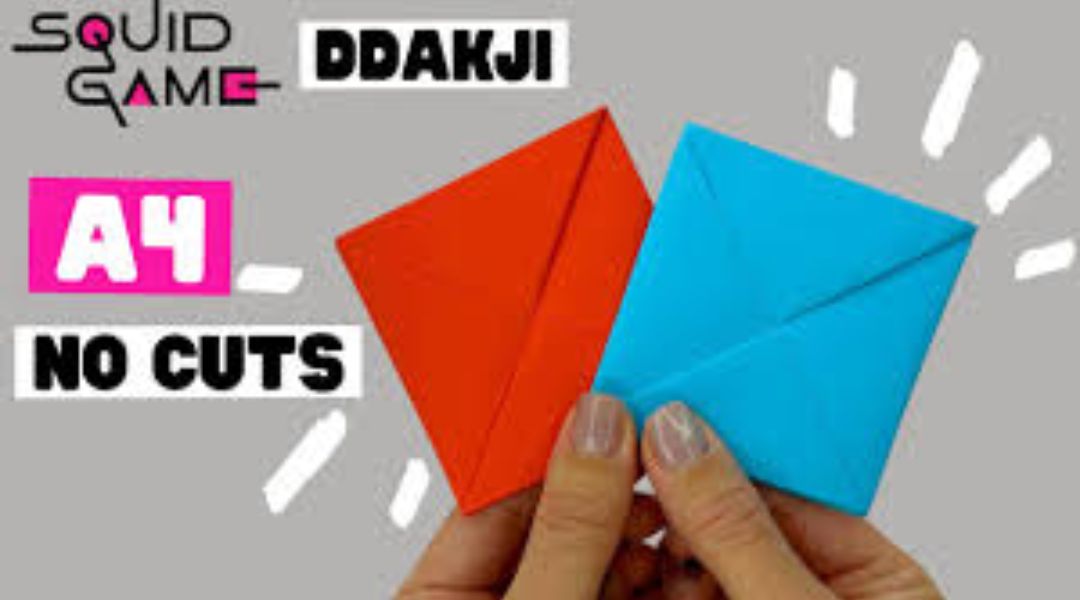
This iconic image shows classic red and blue ddakji tiles, just like those seen in Squid Game.
Materials Needed to Make Ddakji
Gather these simple items before starting:
- Paper: Origami paper, construction paper, printer paper (A4 or letter size), or newspaper. Thicker paper makes sturdier tiles.
- Scissors or paper cutter: For precise cuts.
- Ruler: To measure folds accurately.
- Optional extras: Cardboard scraps (for added weight), markers or stickers (for decoration), glue (only if experimenting with variations).
No tape or glue is needed for the classic methods—everything holds together through clever folding.
Method 1: Simple Square Paper Ddakji (Beginner-Friendly)
This modular origami technique uses square sheets and creates puffy, lightweight tiles.
- Start with squares: Use two square sheets of paper (6–8 inches works well). If using rectangular paper, trim to squares.
- Fold into thirds: Fold one sheet into thirds lengthwise. Crease sharply and unfold. Repeat on the other sheet.
- Fold corners: On the first sheet, fold the left corner up to meet the center crease and the right corner down.
- Make the second unit: Repeat step 3 on the second sheet.
- Join the units: Place the two folded pieces in a cross shape, overlapping in the middle.
- Tuck the flaps: Fold the left and right flaps inward. Then fold the top flap down and tuck it under the right flap. Fold the bottom flap up and tuck it under the left flap.
- Finish: Press firmly. The tile seals itself—no glue needed.
Repeat to make a matching tile. These tiles are lightweight and easy for beginners to flip.
Method 2: Rectangle Paper Ddakji (Thicker, Show-Accurate Style)
This method mimics the heavier tiles from Squid Game. Use a 2:3 ratio for rectangles.
- Cut rectangles: Cut two rectangles per tile (e.g., 7.7 inches by 11.7 inches from larger sheets).
- Mark a grid: Divide the length by 2 and width by 3 to create fold lines.
- Fold in half: Fold along the center lengthwise.
- Create angles: Fold the ends at 45-degree angles, alternating directions to form a parallelogram shape.
- Assemble: Cross the two pieces and fold angled tips inward to form a compact square.
- Press flat: The result is a thicker, more durable tile.
These tiles flip better with practice due to their weight.
Method 3: Easy A4 Paper Ddakji (Quick and Accessible)
Many online tutorials use everyday A4 paper.
- Take two A4 sheets (one for each side of the tile).
- Fold each sheet in half lengthwise, then fold corners and tuck flaps similarly to the square method.
- Cross the pieces and tuck ends securely.
- Optional: Use four sheets (two per side) for extra thickness.
This version is fast and uses what most people have at home.
Tips for Perfect Folds and Strong Tiles
- Crease sharply with your fingernail or a ruler edge.
- Use thicker paper or insert cardboard for heavier tiles that flip easier.
- Experiment with sizes—smaller tiles flip more easily for kids.
- Avoid over-folding; too many creases weaken the tile.
- Practice on scrap paper first.
Common mistake: Loose folds. Solution: Press firmly after each step.
How to Play Ddakji: Rules and Strategies
- Players agree on who throws first (rock-paper-scissors works).
- One player places their tile flat on the ground.
- The other throws their tile from above, aiming to flip the ground tile.
- Success? The thrower wins the flipped tile.
- Continue until one player has all tiles or set rounds.
Winning tips:
- Aim for the puffy center.
- Throw with the flat side down for maximum impact.
- Practice angle and force—too hard causes bounces, too soft does nothing.
The game builds focus and coordination.
Variations and Customizations
- Decorations: Add stickers, draw patterns, or use patterned paper.
- Colors: Traditional red vs. blue, or fun themes.
- Materials: Try cardstock or laminated paper for longevity.
- Team play: Play in groups for bigger matches.
If adding Korean text or designs, explore fonts at fontlu.co.uk.
Educational Benefits of Making and Playing Ddakji
Folding ddakji improves fine motor skills, spatial awareness, and patience. Playing teaches turn-taking, strategy, and handling wins/losses gracefully. It’s a screen-free activity perfect for families or classrooms.
Fun Facts About Ddakji
- Similar to Pogs but without a slammer.
- Played in both North and South Korea.
- Squid Game boosted searches dramatically.
Frequently Asked Questions
How long does it take to learn how to make ddakji? Most people master a basic tile in 10–15 minutes.
Can kids make ddakji safely? Yes—with adult supervision for cutting.
What paper works best? Origami or construction paper for beginners; printer paper for quick tries.
How do I make ddakji flip better? Use thicker tiles and aim precisely.
Conclusion: Get Started with Ddakji Today
How to make ddakji is a fun, accessible craft that connects you to Korean tradition and Squid Game excitement. With simple folds and everyday paper, you can create tiles for hours of play. The game rewards practice, and the crafting process is relaxing and creative.
Gather your paper and start folding—you’ll soon have your own set ready for challenges. Have you tried how to make ddakji yet? Share your favorite folding tip or game win in the comments!
References
- Wikipedia: Ddakji (en.wikipedia.org/wiki/Ddakji)
- Instructables: How to Make Ddakji Origami Tiles From Squid Game
- The Spruce Crafts: How to Make and Play the Korean Ddakji Game
- YouTube Short: How to make DDAKJI with A4 paper from SQUID GAME